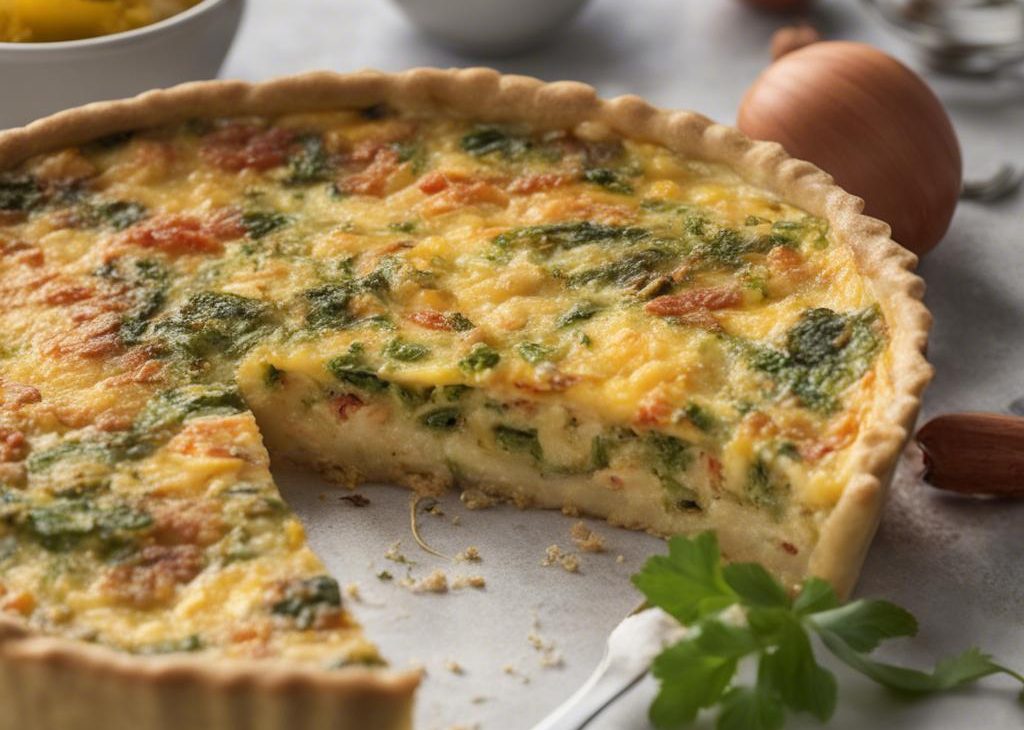
This crustless veggie quiche is what I make when I want a light dinner that still slices like something intentional. There is no crust to roll or blind bake, just vegetables, eggs, egg whites, milk, and cheese in a 9-inch dish.
Because there is no crust, I cook the vegetables first. Squash and zucchini carry a lot of water, and the 6-7 minutes in the skillet gives them flavor while driving off some moisture. If I skip that, the bottom of the quiche is too wet for my taste.
The finished quiche is softer than a classic crusted one, and I expect a little vegetable juice in the pan. I cool it for 10 minutes before slicing, which helps the eggs settle and makes the pieces cleaner.
Why I keep coming back to this
- No crust means less prep and a lighter slice.
- Cooking the vegetables first adds flavor and reduces water.
- Three eggs plus three egg whites give a set but gentle texture.
- A 9-inch pie dish or square pan works.
- It bakes for 45 minutes and serves 6.
- Leftovers keep covered in the refrigerator up to 4 days.
What you need (and what each one is doing)
- 1 1/2 cups sliced yellow squash (about 1 medium yellow squash). It softens quickly and adds sweet summer flavor.
- 1 1/2 cups sliced zucchini (about 1 medium zucchini). It pairs with the squash but needs skillet time to release moisture.
- 1 large orange bell pepper, chopped (or any color). Pepper adds color and a little crunch.
- 2 cloves garlic, minced. Garlic makes the vegetable base taste savory.
- 2 teaspoons dried thyme (or fresh chopped). Thyme gives the eggs a herby backbone.
- 3 large eggs. Whole eggs set the quiche.
- 3 large egg whites. Egg whites lighten the texture.
- 3/4 cup milk. Milk loosens the egg mixture.
- 3/4 teaspoon salt. Salt seasons the eggs; I use only a pinch in the skillet.
- 1/4 teaspoon freshly ground black pepper. Pepper adds a little bite.
- 2/3 cup shredded cheese. Shredded cheese melts through the top.
- 2 Tablespoons grated parmesan cheese. Parmesan adds a salty finish.
How I make it
Step 1 — Cook vegetables
I heat a large skillet over medium-high heat, spray it, and cook squash, zucchini, pepper, garlic, thyme, and a small pinch of salt and pepper for 6-7 minutes. I spoon the vegetables into a bowl to cool slightly.
Step 2 — Prep dish
I preheat to 350°F (177°C) and spray a 9-inch pie dish or square pan.
Step 3 — Whisk eggs
I whisk 3 eggs, 3 egg whites, milk, 3/4 teaspoon salt, and 1/4 teaspoon pepper until no streaks remain.
Step 4 — Pour and combine
I arrange the vegetables in the dish, scatter shredded cheese over them, pour in the egg mixture, and finish with parmesan.
Step 5 — Bake and rest
I bake for 45 minutes, until the center is set and no longer jiggles. Then I cool the dish on a wire rack for 10 minutes before slicing.
Small details I do not skip
I pay attention to the pan, temperature, and resting time here because vegetable-heavy egg bakes can turn watery if the skillet step or cooling step is rushed. The numbers are not decoration; they are what keep the texture where I want it.
I also try to clean as I go. With 110-Calorie Crustless Veggie Quiche, the recipe feels calmer when the measuring cups are out of the way before the final slicing step. That is a small home-cook habit, but it keeps me from rushing the part that matters most.
Tips from my kitchen
- Do not skip the skillet. Raw squash releases too much water.
- Cool vegetables briefly. Very hot vegetables can cook the eggs unevenly.
- Check the jiggle. The center should be set, not sloshy.
- Expect some moisture. The source notes this can happen without a crust.
- Season the eggs. Eggs need salt to taste complete.
Variations I have actually tried
- Broccoli cheddar: Use small cooked broccoli pieces and cheddar.
- Spinach feta: Use cooked squeezed spinach and feta.
- Mushroom swiss: Brown mushrooms well before baking.
- Southwest: Use pepper jack, scallions, and a pinch of cumin.
- Herb swap: Try basil or oregano instead of thyme.
Storing and reheating
Cool leftovers, cover tightly, and refrigerate for up to 4 days. I store slices in shallow containers so they chill quickly.
I reheat slices in the microwave or covered in a 325°F (163°C) oven. If a slice releases moisture, I blot the plate lightly.
What I serve with it
I serve this with toast and fruit for breakfast, or with salad and roasted potatoes for dinner.
Frequently asked questions
Why is there liquid in the bottom?
The source notes this can happen because there are many vegetables and no crust. Cooking vegetables first and resting helps.
Can I use other vegetables?
Yes. Cook them first and avoid very watery vegetables unless you drain or squeeze them.
Can I use all whole eggs?
You can, but the recipe is written with 3 eggs and 3 egg whites for a lighter slice.
What milk works?
Most dairy milk works. Richer milk gives a creamier texture.
How do I know it is done?
The filling should be set and no longer jiggle in the center.
If you make this quiche, tell me which vegetables you used. I am always looking for another fridge-cleanout combination.
One more thing I have learned with 110-Calorie Crustless Veggie Quiche: I get the best result when I slow down at the beginning and set up every measured ingredient before mixing. It sounds fussy, but it prevents the little mistakes I make when butter is soft, the oven is hot, and I am trying to remember whether the salt already went.
I wrote the method in the order I actually use at home. If a bowl needs scraping, a pan needs lining, or a salad needs dressing at the last second, I call that out because those small moments decide whether 110-Calorie Crustless Veggie Quiche tastes intentional or merely assembled.
When I make 110-Calorie Crustless Veggie Quiche again, I write one small note on the printed recipe or in my phone: how the pan behaved, whether the center needed more time, or whether the dressing amount felt right. Those notes are ordinary, but they are exactly what make a repeat batch easier in a real kitchen.
I also taste or check texture before serving instead of relying only on the timer. A timer gets me close; my eyes, a toothpick, or a quick bite tell me whether 110-Calorie Crustless Veggie Quiche is actually ready for the table.
After I know the texture, then I start playing with add-ins and swaps. That order has saved me from several well-meant but strange experiments.