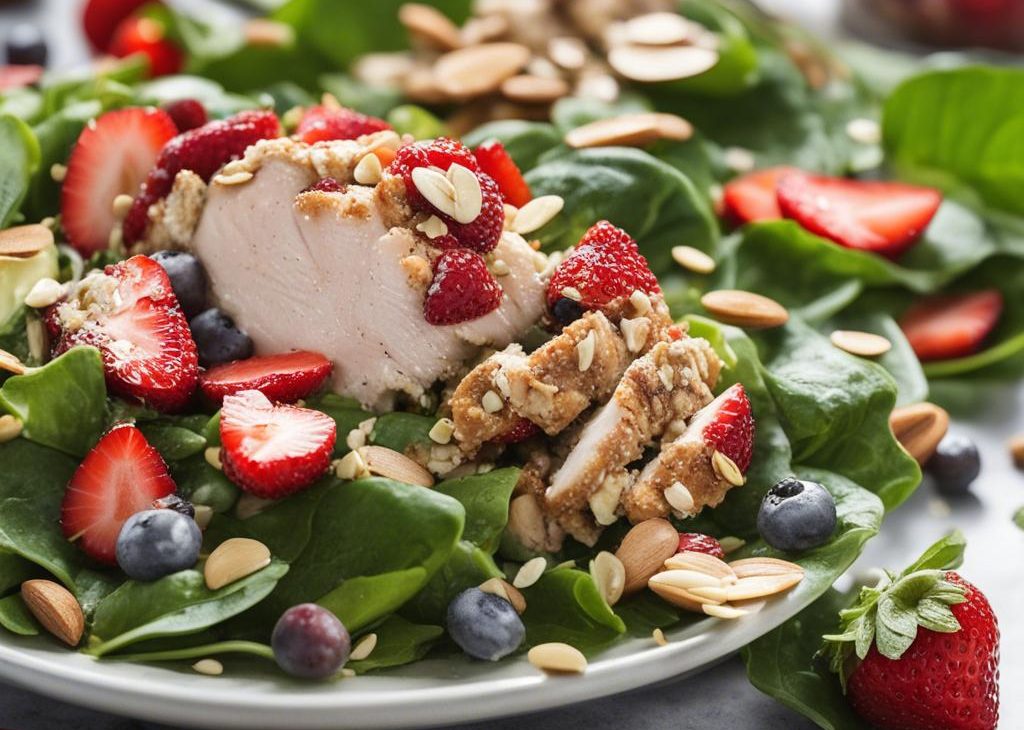
This fresh summer chicken salad is the dinner I want when the kitchen is hot and cooked chicken is already in the refrigerator. It is crisp romaine, blueberries, corn, avocado, almonds, chicken, and a creamy poppy seed dressing.
The source title is a summer dinner roundup, but the recipe card reads like a quick salad, so I treat it as a 10-minute dinner for 2. I whisk the dressing separately and add only as much as the salad needs because overdressed romaine wilts fast.
I like the balance: sweet berries, juicy corn, creamy avocado, crunchy almonds, and enough chicken to make the bowl feel like dinner. Once avocado and dressing go in, I serve it right away.
Why I keep coming back to this
- It takes about 10 minutes with cooked chicken.
- The dressing is creamy without mayonnaise.
- Blueberries and corn make it feel like summer.
- Almonds add crunch without croutons.
- It serves 2 as a dinner salad.
- No oven or stovetop is needed.
What you need (and what each one is doing)
- 6 cups chopped romaine lettuce (about 100g). Romaine gives crisp volume.
- 1 cup fresh blueberries (about 150g). Blueberries add sweet bursts.
- 3/4 cup corn kernels (115g). Corn adds juicy summer sweetness.
- 3/4 cup crumbled feta or goat cheese (135g). A tangy crumble balances the sweet dressing.
- 1/2 ripe avocado, chopped. Avocado makes the salad filling.
- 1/4 cup sliced almonds (22g). Almonds bring crunch.
- 8 ounces cooked chicken, chopped or shredded. Chicken turns the salad into dinner.
- 1/3 cup plain Greek yogurt (80g). Greek yogurt makes the dressing creamy.
- 2 tablespoon olive oil (30ml). Oil loosens the dressing.
- 2 tablespoon apple cider vinegar or white wine vinegar (30ml). Vinegar gives tang.
- 2 tablespoon honey (42g). Honey sweetens the poppy seed dressing.
- 1/4 teaspoon salt. Salt makes the dressing taste finished.
- 1/4 teaspoon ground dry mustard (or 1 teaspoon dijon mustard). Dry mustard adds sharpness.
- 1 1/2 teaspoons poppy seeds. Poppy seeds give the dressing its classic texture.
How I make it
Step 1 — Build the bowl
I toss romaine, blueberries, corn, cheese, avocado, almonds, and chicken in a large bowl. A wide bowl keeps the berries from all hiding at the bottom.
Step 2 — Whisk dressing
I whisk Greek yogurt, olive oil, vinegar, honey, salt, dry mustard, and poppy seeds until smooth. If I use Dijon instead of dry mustard, I whisk a little longer.
Step 3 — Add the remaining ingredients
I pour on part of the dressing, toss, and taste. I add more only if the lettuce needs it.
Step 4 — Serve
I serve immediately while the romaine is crisp and the avocado is bright.
Small details I do not skip
I pay attention to the pan, temperature, and resting time here because lettuce and avocado do not improve after sitting under dressing. The numbers are not decoration; they are what keep the texture where I want it.
I also try to clean as I go. With Fresh Summer Chicken Salad with Poppy Seed Dressing, the recipe feels calmer when the measuring cups are out of the way before the final dressing step. That is a small home-cook habit, but it keeps me from rushing the part that matters most.
Tips from my kitchen
- Use cold chicken. Warm chicken wilts the lettuce.
- Dress in stages. I add some, toss, and taste.
- Cut avocado last. It stays greener.
- Toast almonds if there is time. Two minutes in a dry skillet adds flavor.
- Use ripe berries. Tart berries may need a little extra honey.
Variations I have actually tried
- Strawberry swap: Use sliced strawberries instead of blueberries.
- Turkey: Leftover turkey works like chicken.
- No cheese: Add extra avocado for dairy-free bowls.
- Different nuts: Pecans or walnuts can replace almonds.
- Grain bowl: Add cooked quinoa and serve dressing on the side.
Storing and reheating
The dressed salad should be eaten immediately. For prep ahead, I store lettuce, fruit, chicken, avocado, and dressing separately.
The dressing keeps in a jar in the refrigerator for 3-4 days. I shake or whisk it before using because yogurt and oil can separate.
What I serve with it
I serve this with toasted bread, grilled corn, or soup if dinner needs more heft. On very hot nights, the salad alone is enough for me.
Frequently asked questions
Can I make this ahead?
Prep the parts ahead, but do not toss with dressing or cut avocado until serving.
What chicken works best?
Any cooked chopped or shredded chicken works, including grilled, roasted, poached, or rotisserie.
Can I use Dijon instead of dry mustard?
Yes. The source notes 1 teaspoon Dijon can replace the 1/4 teaspoon ground dry mustard.
Is the dressing very sweet?
It is lightly sweet from 2 Tablespoons honey. Add it gradually so the salad stays balanced.
Can I make it vegetarian?
Yes. Skip chicken and add chickpeas or cooked quinoa for a more filling bowl.
If you make this salad, tell me whether you used blueberries or swapped in another summer fruit.
One more thing I have learned with Fresh Summer Chicken Salad with Poppy Seed Dressing: I get the best result when I slow down at the beginning and set up every measured ingredient before mixing. It sounds fussy, but it prevents the little mistakes I make when butter is soft, the oven is hot, and I am trying to remember whether the salt already went.
I wrote the method in the order I actually use at home. If a bowl needs scraping, a pan needs lining, or a salad needs dressing at the last second, I call that out because those small moments decide whether Fresh Summer Chicken Salad with Poppy Seed Dressing tastes intentional or merely assembled.
When I make Fresh Summer Chicken Salad with Poppy Seed Dressing again, I write one small note on the printed recipe or in my phone: how the pan behaved, whether the center needed more time, or whether the dressing amount felt right. Those notes are ordinary, but they are exactly what make a repeat batch easier in a real kitchen.
I also taste or check texture before serving instead of relying only on the timer. A timer gets me close; my eyes, a toothpick, or a quick bite tell me whether Fresh Summer Chicken Salad with Poppy Seed Dressing is actually ready for the table.
After I know the texture, then I start playing with add-ins and swaps. That order has saved me from several well-meant but strange experiments.