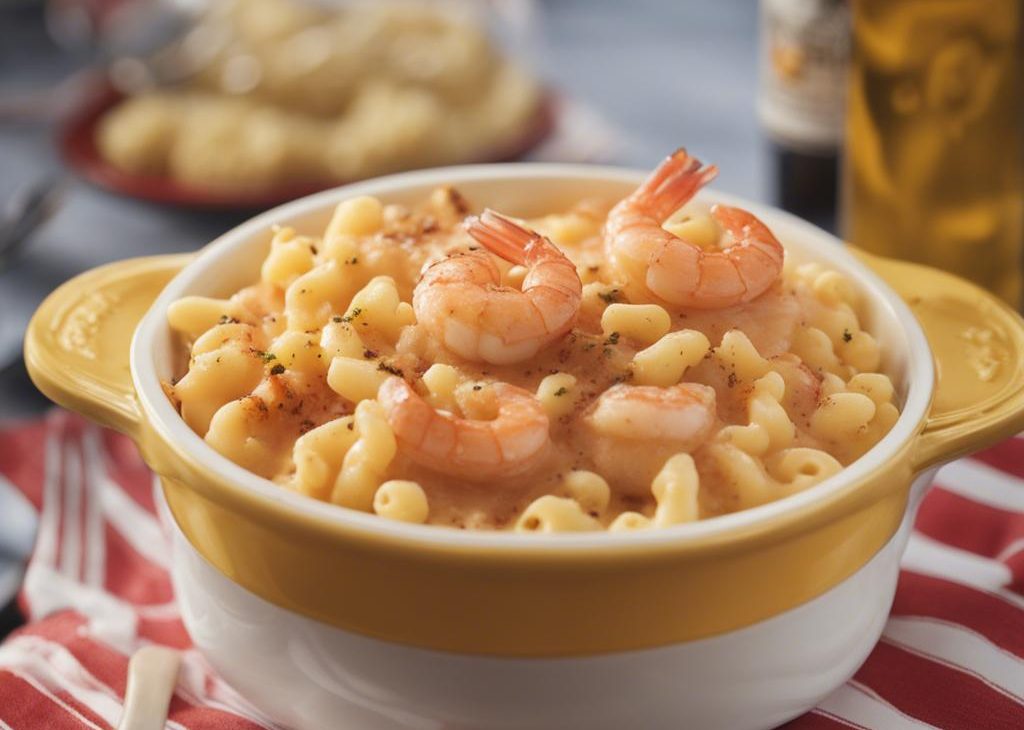
This is my home-kitchen take on the shrimp mac and cheese Bubba Gump Shrimp Co. used to put on their menu — a baked, cheesy, slightly spicy pasta with plump shrimp folded through it. I have eaten the restaurant version maybe twice in my life, but the memory of that crispy Parmesan top stuck with me, so I worked on a version I could make on a Tuesday night without dropping forty dollars on dinner.
I want to be honest up front: this is not the official restaurant recipe. It is a copycat I tested over several rounds in my own kitchen, adjusting butter and seasoning until the ratio felt right for a normal-sized pan. If you came here looking for the exact corporate spec, I do not have it. What I do have is a version that tastes a lot like what I remember, and that scales sanely.
Below is the full method, the small choices that actually matter, and the substitutions I have personally made when I was missing an ingredient.
Why this version works
- Real béchamel base — butter, flour, and whole milk — gives the sauce body so the cheese melts in evenly without breaking.
- Cajun seasoning goes on the shrimp, not in the sauce, so the spice stays bright and the cheese stays creamy.
- Two cheeses for flavor (Cheddar for tang, Monterey Jack for melt), plus a Parmesan-breadcrumb top for that crispy lid.
- One-pan-and-a-pot weeknight cooking. Big-batch enough for 8, leftovers reheat well.
Ingredients, and why each one is doing what it is doing
- Elbow pasta, 1 pound. Classic for a reason — the curve catches sauce on the outside and traps it in the middle. Cavatappi works if you want a twistier shape. Avoid long pasta; it does not hold up to baking.
- Butter, 6 tablespoons total. 2 tablespoons for searing the shrimp, 4 tablespoons for the roux. The original recipe I worked from called for 4 sticks of butter, which is the kind of thing that happens when a number gets typed wrong somewhere — please do not use 4 sticks for 8 servings.
- Medium shrimp, 1 pound, peeled and deveined. I leave the tails off because nobody at my table wants to wrestle them out of the pasta. Frozen shrimp work great here — just thaw in cold water for 15 minutes and pat very dry before searing.
- Cajun seasoning, 1 teaspoon. Use a brand you like; they vary a lot in salt level. I use Slap Ya Mama or Tony Chachere’s. If yours is very salty, hold back on the salt at the end.
- Onion, 1 tablespoon, finely diced. A small amount — it is here for background sweetness, not to be a starring vegetable. Shallot is a fine substitute.
- All-purpose flour, 3 tablespoons. Thickens the milk into a smooth sauce. Equal weight gluten-free 1-to-1 flour works.
- Whole milk, 3 cups. Whole milk gives the sauce richness without needing cream. 2% works but the sauce will be thinner; I do not recommend skim.
- Shredded sharp cheddar, 2 cups (about 8 oz). Tang. Always grate from a block — pre-shredded cheese is coated in anti-caking starch that makes the sauce grainy.
- Shredded Monterey Jack, 2 cups (about 8 oz). Melt. Same rule: grate it yourself.
- Freshly grated Parmesan, 1/2 cup. For the crispy top. A cup felt like too much when I tested it; half a cup gives you the savory crust without overwhelming the cheese sauce.
- Fresh breadcrumbs, 4 tablespoons. Panko works and gives a louder crunch. Stale bread blitzed in a food processor is what I use when I have a half-loaf I need to use up.
- Salt and pepper to taste. Salt the pasta water, salt the shrimp, then taste the sauce at the end before adding more.
- Chopped fresh parsley, 2 teaspoons. Color and a fresh note over the top after baking.
Step-by-step
Step 1 — Heat the oven and boil the pasta
Preheat the oven to 375°F (190°C). Bring a large pot of well-salted water to a boil and cook the elbow pasta for 1 minute less than the box says — it will finish cooking in the oven. Drain and set aside. I do not rinse it; the starch helps the cheese sauce cling.
Step 2 — Sear the shrimp
Pat the shrimp very dry with paper towels — this is the difference between a sear and a steam. Toss them with the Cajun seasoning. In a large skillet, melt 2 tablespoons of butter over medium-high heat. Add the shrimp in a single layer and cook for about 1 minute per side, until they curl into a loose C and turn pink. Lift them out into a bowl and set aside. They will keep cooking in the oven later, so pull them just shy of done.
Step 3 — Build the roux
In the same skillet, melt the remaining 4 tablespoons of butter over medium heat. Add the diced onion and cook for 2 minutes, stirring occasionally, until it softens but does not brown. Sprinkle the flour over the butter and onion and whisk constantly for about 1 minute — it will form a pale paste. This is the roux. You want it cooked enough to lose the raw-flour taste, not browned.
Step 4 — Whisk in the milk
Pour the milk in gradually, whisking the whole time. Lumps form when milk hits hot roux all at once, so add about half a cup, whisk smooth, then another half cup, whisk smooth, and so on. Once all the milk is in, raise the heat to medium-high and bring it to a low simmer, whisking. After about 4-5 minutes it will thicken to a coat-the-back-of-a-spoon consistency.
Step 5 — Melt in the cheese
Reduce the heat to low. Add the cheddar and Monterey Jack a handful at a time, whisking between additions until each handful is melted before you add the next. Going too fast or too hot is how cheese sauces break. Once all the cheese is in and smooth, taste and add salt and pepper. Remember the Cajun seasoning on the shrimp will add more salt to the final dish.
Step 6 — Combine and top
Tip the drained pasta into a 9x13-inch baking dish. Pour the cheese sauce over it and fold in the cooked shrimp. Stir until everything is evenly coated. Sprinkle the Parmesan over the top, then the breadcrumbs.
Step 7 — Bake until the top is golden
Bake for 15-20 minutes, until the top is golden brown and the edges are bubbling. If your top is not browning enough by the 18-minute mark, run it under the broiler for 1-2 minutes — just stay with it, breadcrumbs go from golden to black in seconds. Pull from the oven, scatter the chopped parsley over the top, and let it rest 5 minutes before serving so the sauce sets up enough to scoop cleanly.
Tips from my kitchen
- Grate your own cheese. I know I said it twice already. It is the difference between silky and grainy. Worth the 90 seconds.
- Pasta one minute under. It keeps cooking in the oven inside the cheese sauce; cooking it to package directions first gives you mushy pasta.
- Dry the shrimp. Wet shrimp release water into the pan and you end up boiling them instead of searing. Paper towels, both sides, press.
- Taste before salting. Cajun seasoning, cheddar, and Parmesan all carry salt. I have over-salted this dish more than once.
- Resting matters. 5 minutes out of the oven and the sauce sets enough to portion neatly. Straight out it slumps.
Variations I have actually tried
- Spicier: Add 1/4 teaspoon cayenne to the roux, or a few dashes of hot sauce stirred into the cheese sauce.
- Smokier: Swap 1/2 cup of the Monterey Jack for smoked gouda.
- Lobster version: Replace the shrimp with 1 pound of chopped cooked lobster meat, folded in just before baking so it does not turn rubbery.
- Vegetable add-ins: 1 cup of par-cooked broccoli florets or sauteed spinach folded in with the shrimp. The broccoli holds up better.
- Gluten-free: Use GF elbow pasta and a 1-to-1 GF flour blend for the roux. Texture is basically identical.
What to serve with it
This is a rich dish, so I aim for sharp and fresh on the side. A simple green salad with a lemony vinaigrette works. Steamed or roasted broccoli is the kid-approved option at my house. Garlic bread doubles down on the comfort if you have very hungry people. I would skip another creamy or cheesy side — the mac is doing that job already.
Storing and reheating leftovers
Cool to room temperature, then store leftovers in an airtight container in the fridge for up to 3 days. To reheat, transfer to a baking dish, sprinkle a couple of tablespoons of milk over the top to bring back the creaminess, cover with foil, and bake at 350°F (175°C) for 15-20 minutes until heated through. Microwave works too: 60 seconds, stir, 60 seconds, stir, with a splash of milk first.
I do not love freezing this one — the shrimp texture suffers and the cheese sauce can get a little grainy on the thaw. If you must, freeze before the bake, in a foil pan, for up to a month. Thaw overnight in the fridge before baking.
Frequently asked questions
Can I use pre-cooked shrimp?
Yes, but skip Step 2 — just toss them with the Cajun seasoning and fold them into the sauce raw-from-the-bag in Step 6. They will warm through in the oven without overcooking.
Is this the actual Bubba Gump recipe?
No. This is my home version, inspired by what I remember from the menu. The real corporate recipe is not public. I scaled this one to work in a normal-sized 9x13 pan and tested it in my own oven until it tasted right to me.
Why did my sauce break?
Almost always one of three things: the heat was too high when adding the cheese, the cheese was added too fast, or the cheese was pre-shredded. Keep the heat low at Step 5, add a handful at a time, and grate from a block.
Can I make this ahead?
Yes — assemble through Step 6, cover, and refrigerate up to 24 hours before baking. Add 5-10 extra minutes in the oven since you are starting cold. Hold off on the breadcrumbs until just before baking so they stay crisp.
Can pregnant women eat this?
Generally yes, as long as the shrimp is fully cooked (opaque all the way through, internal temperature 145°F / 63°C) and the dish is served hot from the oven. As always with pregnancy questions, your healthcare provider knows your situation; ask them if you are unsure.
Can I halve the recipe?
Yes. Use half of every ingredient and bake in an 8x8-inch dish for 12-15 minutes. The cook time is shorter because there is less mass to heat through.
If you give this a try, drop a comment and let me know how it landed — especially if you tweaked the spice level or tried one of the cheese swaps.