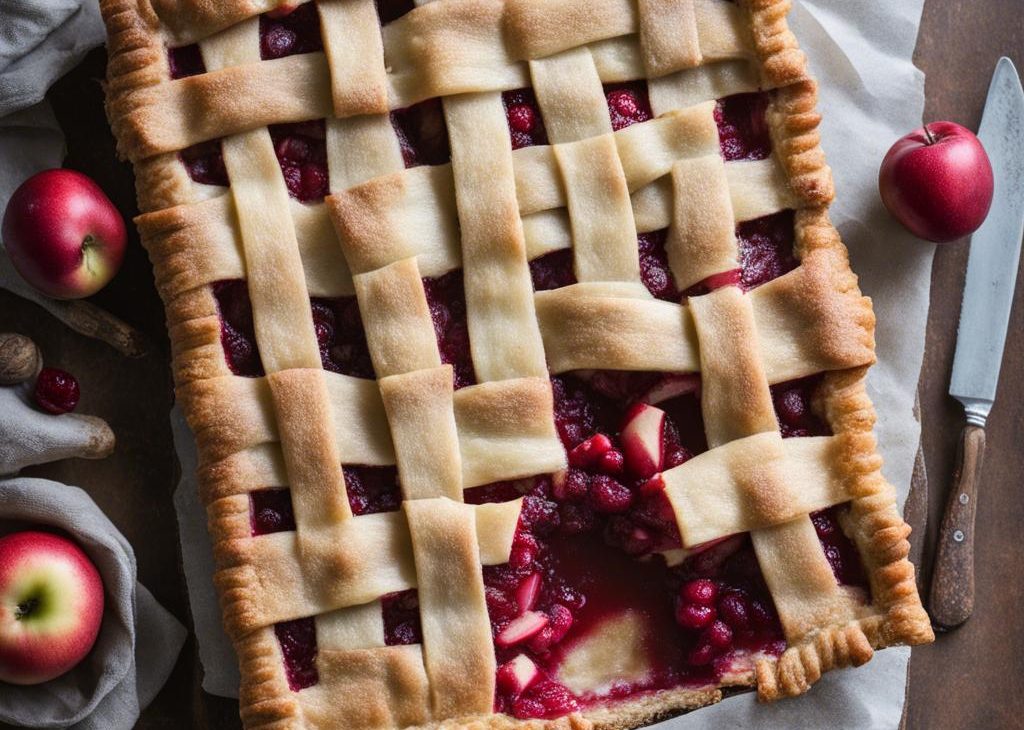
This Cranberry Apple Slab Pie is the fruit pie I make when I want the flavor of a classic holiday pie but not the height and drama of a deep dish. It bakes free-form on a sheet pan, which makes it flatter, easier to slice, and wonderfully rustic.
The filling is tart-sweet: apples, cranberries, sugar, cornstarch, orange zest, cinnamon, allspice, nutmeg, and little dots of butter. The cranberries burst into the apples and make the filling taste brighter than apple pie alone.
The crust needs to be rolled thin enough and sealed well. I have had leaks with slab pie, and they are not the end of the world, but chilling the assembled pie before baking helps the crust hold its shape.
Why I keep coming back to this
- It serves 8 in tidy rectangles instead of tall wedges.
- The free-form shape is forgiving and does not require a pie plate.
- Cranberries cut through the sweetness of the apples.
- Orange zest makes the fruit taste lively without adding more liquid.
- The pie only needs 5 minutes of cooling before slicing.
- The flatter shape gives a high crust-to-filling ratio, which I love.
What I use and why it matters
- Two pie crusts. I use one for the bottom and one for the lattice or top crust.
- Extra flour. A light dusting keeps the dough from sticking while I roll.
- Egg wash. Egg beaten with water gives the crust a shiny golden finish.
- Apples, 5 cups. I use firm baking apples so the filling does not collapse.
- Cranberries, 1 cup. Fresh or frozen berries add tart pops.
- Sugar and cornstarch. Sugar sweetens; cornstarch thickens the juices.
- Orange zest and warm spices. Zest, cinnamon, allspice, and nutmeg make the fruit smell like fall.
- Butter, 1 tablespoon. Small dots of butter enrich the filling as it bakes.
Small prep details that help
Before I start Cranberry Apple Slab Pie, I read through the steps once and set out the pieces that usually slow me down: a sharp knife, a clean board, measuring spoons, the right pan, and a towel for quick cleanup. That small pause keeps me from making rushed choices once heat or dressing or dough is involved. I also check the ingredient temperatures. Cold dairy, wet greens, damp seafood, or a chilled roast can all change timing, so I would rather notice that at the counter than halfway through cooking.
I measure the seasonings into small piles or bowls when the recipe moves quickly. It feels fussy for about thirty seconds, then it pays me back when I am not trying to open a spice jar with messy hands. I also decide where the finished food will land before I begin. A wire rack, serving platter, clean jar, or cooling space may sound minor, but I have learned that good food gets clumsy fast when I am hunting for a place to put a hot pan.
How I make it
Step 1 — Prepare the crust
I prepare the pie crust through chilling. I line a half sheet pan with parchment or a silicone baking mat and make room in the refrigerator because the assembled pie needs at least 15 minutes of chilling.
Step 2 — Mix the filling
In a large bowl, I stir together the apples, cranberries, sugar, cornstarch, orange zest, cinnamon, allspice, and nutmeg. I set the filling aside while rolling the dough.
Step 3 — Transfer
On a lightly floured surface, I roll one disc of dough into a rectangle around 10x14 inches and about 1/8 inch thick. I turn and lightly flour the dough as needed so it does not stick, then transfer it to the lined pan.
Step 4 — Pile and fold
I pile the filling tightly onto the dough, leaving a 1.5-inch border. I discard excess juices in the bowl, dot the filling with butter, fold the dough edges over the filling, and pinch the corners.
Step 5 — Add the top crust
I roll the second crust to the same thickness and cut strips for a lattice, or I lay it over the filling and cut vents. I seal the top and bottom edges together, folding extra dough back to make a thicker border.
Step 6 — Chill and bake
I brush the dough with egg wash, refrigerate the assembled pie uncovered for 15 minutes, and preheat the oven to 375°F (190°C). I bake for 45-55 minutes, until the crust is golden and juices bubble for at least 5 minutes.
Step 7 — Cool briefly
I cool the slab pie for 5 minutes before slicing and serving. The short cool time is one reason I love this style of pie.
What I watch for
The clock gives me a starting point for Cranberry Apple Slab Pie, but I do not let it make the final decision. I watch the texture, the smell, and the way the food sits in the pan. If something is browning before the center is ready, I lower the heat, cover loosely, or move the pan. If something looks pale or watery, I give it more space, more time, or a few minutes uncovered. That kind of small adjustment is usually what separates a dependable batch from one that tastes rushed.
I also taste or check seasoning at the point where it can still be fixed. For salads and dressings, I taste on a leaf, cracker, or piece of vegetable instead of a plain spoon. For casseroles and baked dishes, I taste the sauce or filling before it is covered. For meat and fish, I trust temperature first and appearance second. I have ruined more food by guessing than by taking ten seconds to check.
If a batch does not behave exactly the way I expected, I try to make one calm correction instead of three panicked ones. A splash of liquid can loosen a thick sauce. A few uncovered minutes can dry a wet top. A pinch of salt can wake up a flat filling. A short rest can turn a messy scoop into a clean serving. I build those little fixes into my cooking now because real kitchens are never as tidy as written instructions.
Tips from my kitchen
- Keep the dough moving. I rotate and lift it as I roll so it does not glue itself to the counter.
- Discard extra juice. Too much liquid encourages leaks and a soft crust.
- Chill before baking. A cold assembled pie holds its shape better in the oven.
- Look for bubbling juices. Golden crust alone does not prove the cornstarch has activated.
- Use parchment. If some filling leaks, parchment saves the pan and my mood.
Variations I have actually tried
- Pear cranberry: I replace half the apples with firm pears.
- Orange glaze: I drizzle cooled slices with powdered sugar mixed with orange juice.
- Full top crust: I skip the lattice and cut 3-5 vents in the top crust.
- Extra tart: I add another handful of cranberries and serve with vanilla ice cream.
- Nutty edge: I sprinkle coarse sugar and finely chopped pecans over the egg wash.
Storing and making it ahead
I cover leftovers tightly and refrigerate them for up to 5 days. The crust softens slightly but still tastes buttery.
To reheat, I warm slices on a sheet pan at 325°F until the crust wakes up. I avoid microwaving if I care about crispness.
What I serve with it
I serve this slab pie warm with vanilla ice cream, lightly sweetened whipped cream, or sharp cheddar on the side. It also works at room temperature on a dessert tray because the slices are easy to pick up.
Frequently asked questions
Can I use store-bought crust?
Yes. I use two crusts and roll them thin enough for the slab shape.
Can I use frozen cranberries?
Yes. I add them frozen and do not thaw, which helps keep the filling from getting watery.
Why did my pie leak?
The filling may have been too juicy, the edges may not have sealed, or the dough got warm. I chill before baking and use parchment.
Do I need a lattice?
No. A full top crust with vents works well and is faster.
How do I know it is baked?
The crust should be golden and the juices should bubble through the lattice or vents for at least 5 minutes.
If you bake this slab pie, I would love to know whether you made a lattice or chose the easier full top.