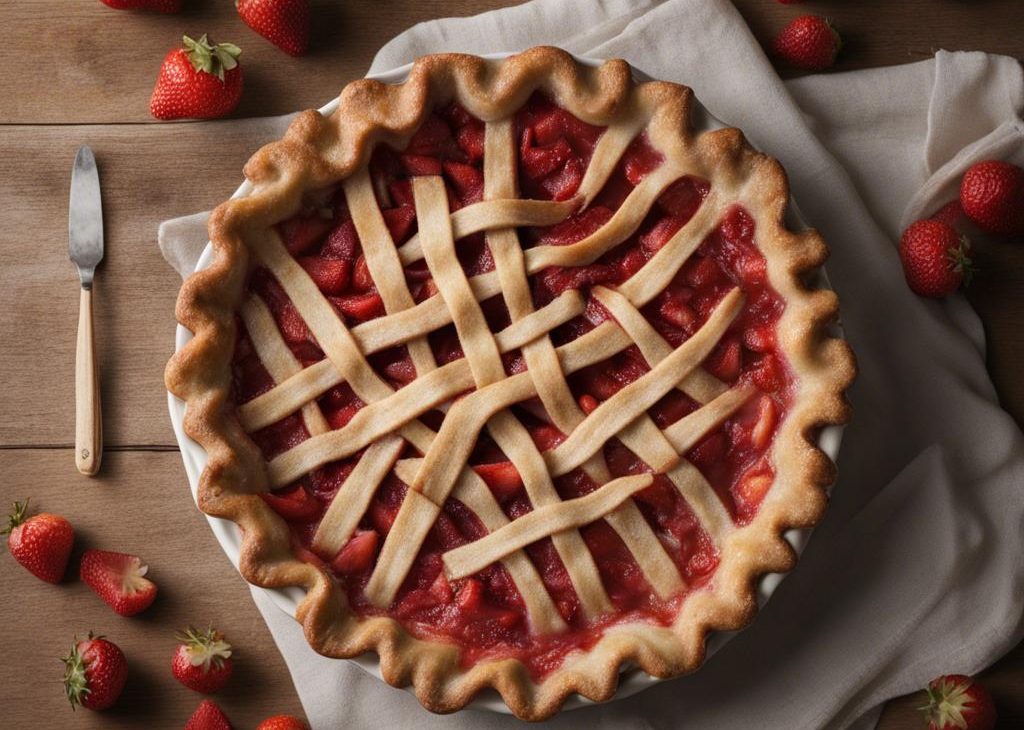
I did not always understand Strawberry Rhubarb Pie. Rhubarb looked like tart celery to me, and I could not imagine why anyone would tuck it into dessert. Baking with it changed my mind because strawberries, sugar, and enough patience turn it into a bright fruit filling.
This is the pie I make when I want ruby slices that taste sweet, tart, and buttery all at once. The strawberries soften into syrup, the rhubarb keeps a sharp edge, and a little orange juice and vanilla make the filling smell warmer without covering the fruit.
The hardest part is waiting 3 full hours before cutting. I have sliced too early and watched the filling slide out in a glossy puddle. Now I bake it on a sheet pan, cool it like I mean it, and get cleaner wedges.
Why I keep coming back to this
- The filling uses brown sugar and granulated sugar for a rounder flavor.
- Cornstarch thickens the fruit without making the texture heavy.
- Leaving excess juice in the bowl protects the bottom crust.
- The two-temperature bake starts hot, then finishes gently.
- A crust shield after 20 minutes keeps the edge from over-browning.
- A full cool-down makes the difference between pie filling and fruit sauce.
I also like recipes that leave room for real kitchen conditions. If the fruit is a little softer, the dough a little warmer, or the pan takes a few extra minutes, I can adjust without feeling like the whole thing has gone wrong. That kind of flexibility is what makes me repeat a recipe again in my own kitchen.
What I use and why it matters
I keep the dough cold and the fruit pieces small. Those two details make assembly easier and help the filling bake evenly inside the 9-inch pie dish.
Before I start Strawberry Rhubarb Pie, I set out the ingredients in the order I will use them. It sounds fussy, but it keeps me from discovering a missing egg wash, cold cream, or measured sugar at the wrong moment. I also read the full method once because several of these recipes have a cooling or chilling step that matters as much as the mixing.
- Homemade pie crust. I use two chilled crusts, one for the bottom and one for the lattice or top crust.
- Rhubarb and strawberries. I use 3 cups rhubarb and 2 1/2 cups strawberries, measured after chopping.
- Brown sugar and granulated sugar. Each brings something different; brown sugar tastes deeper, while granulated sugar keeps the fruit bright.
- Cornstarch. The full 1/4 cup catches the juices from this very juicy filling.
- Salt, orange juice, and vanilla. Salt sharpens flavor, orange juice lifts the fruit, and vanilla softens rhubarb's tart edge.
- Butter, egg wash, and coarse sugar. Butter enriches the filling, while egg wash and sugar give the top crust color and crunch.
How I make it
Step 1 — Prepare the crust
I prepare my pie crust through the chilling step so both disks are cold. Cold dough rolls cleaner, weaves easier, and bakes flakier. I keep one disk in the refrigerator while I work with the other.
Step 2 — Mix the filling
I stir rhubarb, strawberries, both sugars, cornstarch, salt, orange juice, and vanilla in a large bowl. Then I let the filling sit while the oven heats to 400°F (204°C). The fruit releases liquid during this short wait.
Step 3 — Shape the cookies
I roll one chilled dough disk into a 12-inch circle and settle it into a 9-inch pie dish without stretching. I spoon in the fruit and leave the extra liquid behind in the bowl, then dot the filling with butter.
Step 4 — Shape the cookies
I roll the second disk into a 12-inch circle and cut strips 1/2- to 1-inch wide for a lattice. If I do not feel like weaving, I use the full top crust and cut vents. Either way, I trim and crimp the edges.
Step 5 — Bake
I brush the top with egg wash, add coarse sugar if I have it, and set the pie on a large baking sheet. I bake 20 minutes at 400°F (204°C), then lower to 350°F (177°C) and bake 30-35 minutes more.
Step 6 — Cool completely
I cool the pie at room temperature for 3 full hours. This is not optional in my kitchen. The filling thickens as it rests, and the slices look much better when I wait.
Small details I do not skip
I look for bubbling in the center, not only around the edge. If the crust is browning before the filling is ready, I add a shield or loose foil. A pie that looks deeply golden and bubbles slowly in the middle is the one I trust.
I also give myself a little buffer around the timing. Ovens run differently, fruit can be juicier one week than the next, and dough changes with room temperature. I use the listed minutes as my guide, then I look for the cues in the recipe: bubbling fruit, set centers, golden edges, puffy dough, or a clean toothpick. That habit has saved me from both under-baked middles and over-browned tops.
Tips from my kitchen
- Do not stretch the dough. I lift and settle it into the dish so it does not shrink.
- Spoon the fruit. I leave the extra liquid in the bowl.
- Watch center bubbles. Edge bubbling alone is not enough.
- Shield the crust. Foil saves the edge after the first 20 minutes.
Variations I have actually tried
- Crumble top: I skip the lattice and use a brown sugar oat crumble.
- Lemon instead of orange: I swap in lemon juice when berries are very sweet.
- Extra vanilla: I increase vanilla to 1 teaspoon for a softer filling flavor.
- Full top crust: I cover the pie with the second crust and cut steam vents.
- Hand pies: I use scraps and a little filling for small folded pies.
Storing and reheating
I cover leftovers tightly and refrigerate them for up to 5 days. The crust is crispest on day one, but slices rewarm nicely at 325°F (163°C) for 10-12 minutes. I avoid the microwave unless speed matters more than flake.
How I serve it
I like this pie slightly warm or at room temperature. Vanilla ice cream is classic, but lightly sweetened whipped cream lets the rhubarb tang stay upfront.
I like to taste the first serving without adding much else, then I decide what it needs. Sometimes that means ice cream, sometimes coffee, sometimes nothing at all. The point is to let the fruit and butter come through instead of hiding the work I already put into the recipe.
Frequently asked questions
Do I have to use homemade pie crust?
I use homemade pie crust because the filling is juicy and needs a sturdy, flaky shell. Store-bought crust can work, but I keep it cold and use a 9-inch pie dish.
Why do I leave liquid in the bowl?
The fruit releases syrup while the oven heats. I spoon the filling into the crust and leave extra liquid behind so the pie thickens instead of flooding.
Can I use frozen rhubarb?
Yes, but I thaw and drain it well before measuring. If it still feels wet, I blot it so the cornstarch can do its job.
How do I know the pie is done?
I look for bubbling filling in the center, not just at the edges. The crust should be deeply golden and the juices should look glossy and thick.
Can I skip the lattice?
Absolutely. I sometimes place the second 12-inch crust over the filling, cut steam vents, trim, and crimp. A crumble topping also works.
If you bake this, tell me if you went lattice, full top crust, or crumble — I keep changing my mind about my favorite.